Student Experience




Pioneering a Transformative Student Experience…
At DCU, we are committed to giving students a world-class education that prepares them to thrive an unscripted future. Through our innovation in teaching and learning, focus on excellence, and our state-of-the-art student facilities, we empower our students to reach their full potential. This transformative university experience is amplified by the generosity of our philanthropic partners, who support vital programmes to advance inclusion in higher education and create opportunities for students to innovate and excel.

Student Experience initiatives supported by philanthropy in 2024/25 included:
Access Scholarships
Access Outreach
University of Sanctuary
Colm Delves Leadership Lab
Memorial and Endowed Scholarships
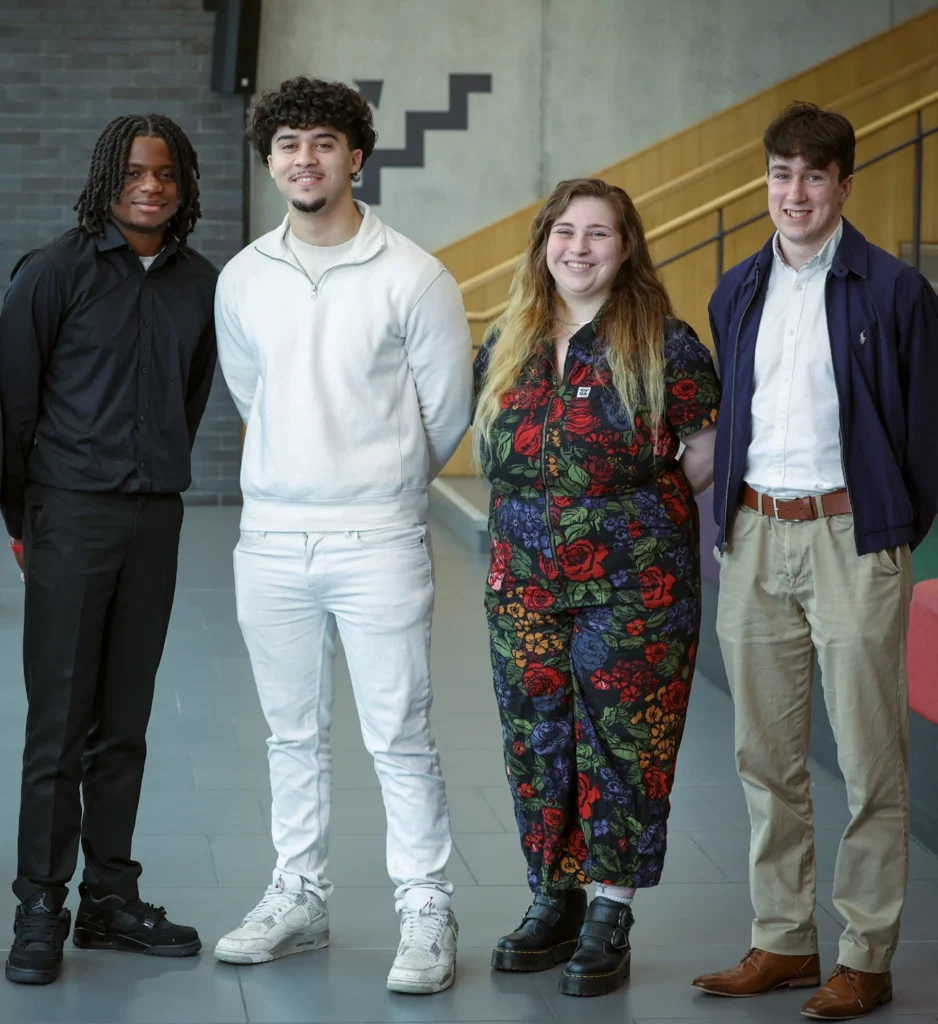
In 2024/25, we were pleased to award 31 scholarships created in memory of some of the University’s most cherished past students, staff and friends. A further 14 students were endowed scholarships and ICON scholarships, generously created by friends and supporters of the university. This year, a total of six new fully funded doctoral scholarships were also awarded at the event, supporting talented PhD students to pursue research with impact in the fields of cancer research, health psychology and inclusive education. These include the Paula and Hannah Delves Scholarship, the Deloitte Access PhD Scholarship, and four Autism Education PhD Scholarships, created through matched funding from philanthropist Paul Kerley and Bank of Ireland.
Collaborative Learning in DCU Business School
In 2025, DCU Business School completed the development of two collaborative learning spaces thanks to generous philanthropic support. A new Challenge Based Learning laboratory has created the ideal environment for active learning and collaborative group work. Equipped with interactive learning tools and a focus on supporting students to solve real-world challenges, this dynamic learning space was made possible by the generous support of DCU alumnus Patrick Thorpe and Searing Point Wealth Management. Philanthropic support has also created a dedicated space for PhD students and academic staff to read, reflect, collaborate, and share ideas: the Research Reading and Seminar Room. Supported by business leader Cathal Friel and Raglan Capital, this research-focused space strengthens the School’s ambition to build a world-class research centre in Business and Society.
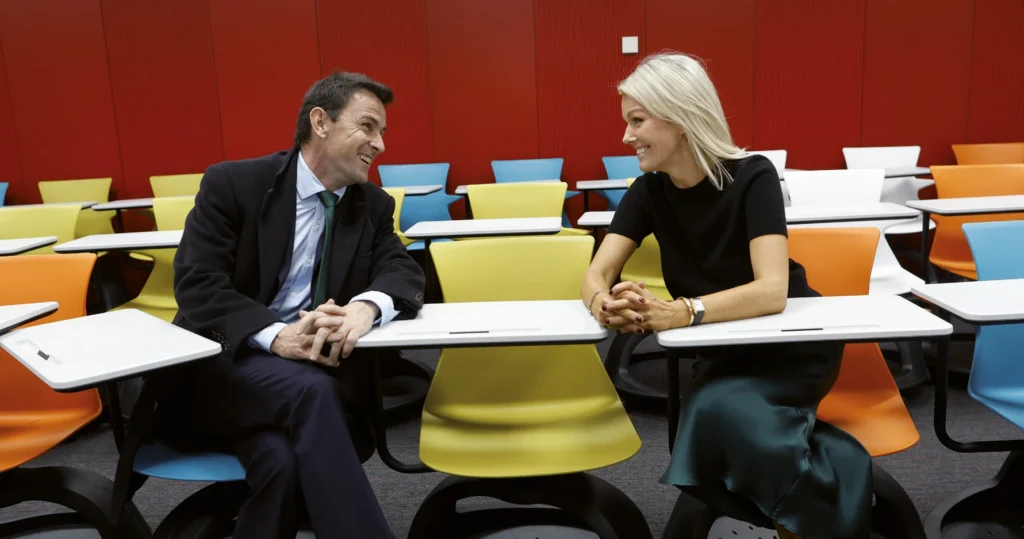
Patrick and Sandra Thorpe in the Challenge Based Learning Lab
DCU Sport
In 2024/25, DCU was named Sports College of the Year at the Student Sport Ireland Awards. In addition to supporting dual-career athletes to successfully balance their academic and sporting commitments, DCU has over 36 sport clubs with 6,282 members across a range of disciplines, catering to all students from casual players to elite level athletes. Sporting highlights in 2024/25 included winning the Sigerson Cup and the O’Connor Cup, the top men’s and women’s collegiate Gaelic football competition, taking home the SSI Brendan Johnston Cup in men’s rugby and the SSI/IRFU Cup in women’s rugby, and achieving athletics gold at the Irish University Athletics Association Championships. The work of DCU Sport is advanced by sponsor Azets Ireland, DCU Sport Scholarship Fund supporters Fidelity Investments and Londis, and Decathlon, promoting student physical activity and empowering student athletes to excel.

Focus on:
DCU Polaris
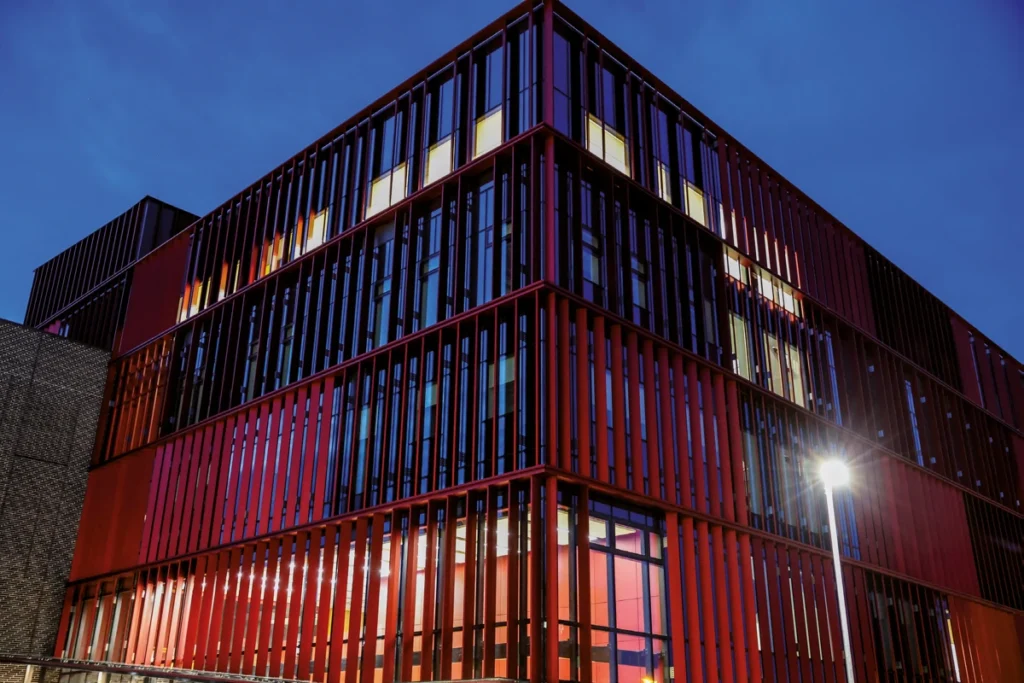
Polaris, DCU’s new landmark building, unites science, health, and engineering under one roof—featuring cutting-edge labs, collaborative spaces, and a net-zero energy design at the heart of campus innovation.
Unveiled by Taoiseach Michéal Martin in April 2025, Polaris is designed to take DCU’s teaching, learning and research in STEM subjects to the next level. With 10,000 square metres of floor space, Polaris can accommodate over 3,000 students from the Faculty of Science and Health, and the Faculty of Engineering and Computing.
Polaris now includes a High Performance Lab focused on research with elite athletes, a LifeLab to help children and teenagers develop improved health literacy, and a Movement Lab that provides state-of- the-art indoor sport facilities for students of physical education, sport science and athletic therapy. Meanwhile, in the Biomechanics Lab, researchers have a purpose-built environment to study, analyse and record human movement.
Dr Sarahjane Belton was Head of the School of Health and Human Performance during the planning phase of the project. Previously, staff at the school operated in four different buildings. With colleagues all in one facility, the benefits for research are already clear. “That’s already fostering links and cross-collaboration, which we were pretty good at, but now it’s going to explode,” says Dr Belton.
“It's lovely and bright and clean. You have everything you need, and it's a really great place to do work and be productive.”
Rían Gill, Mechatronic Engineering student
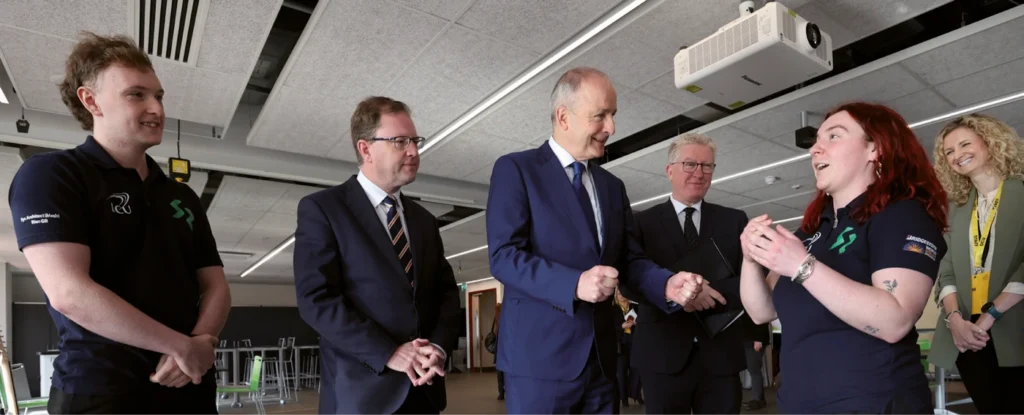
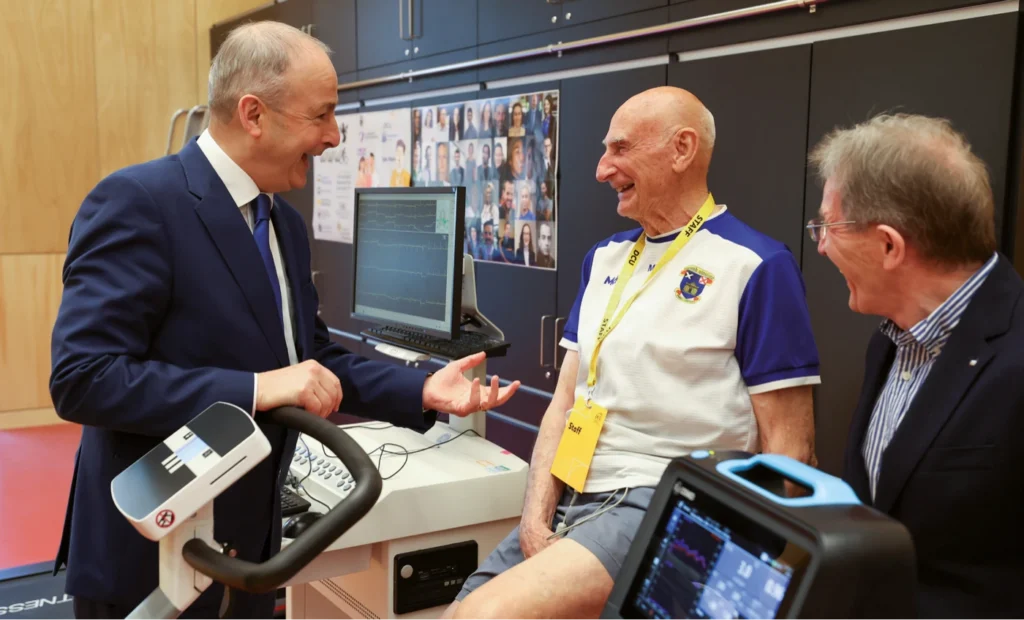
Taoiseach Michéal Martin at the launch of DCU Polaris
Now that it is complete, Polaris has an ‘A’ Energy Rating and is designed to be a Net Zero Energy building, with heat pump technology, solar panels on the roof, and a rain collection system that irrigates the landscaping around the building. “It’s the first building in DCU that’s fully electric, so we’re not using any fossil fuels,” says Alan Mangan of DCU Estates, who was Polaris Project Manager.
As well as its advanced teaching and learning spaces and lecture theatres, a great deal of thought was put into providing social spaces for students.
“It comes down to how people move through the building and how they interact with each other,” remarks Alan Mangan.
Dean of the Faculty of Engineering and Computing, Dr Jennifer Bruton, says Polaris provides an ideal platform to involve key industry and international partners.
“The Faculty has always been highly engaged with industry, enterprise, and overseas partnerships. In Polaris, we have a new set of networked purpose-built spaces, such as the Industry Robotics Lab and the Internet of Things Lab, where we can effectively support research-led, future-focused engineering education that includes both physical and virtual stakeholder involvement in content design and delivery, challenge-based projects, and student exhibitions. It marks a new and invigorating era for the faculty.”
Philanthropic supporters of this innovative space for teaching, learning and research include the Sunflower Charitable Foundation, the Wright Family, and Intel Ireland. As our new facility begins to unlock new possibilities, opportunities are continuing to develop for visionary partners to be part of the Polaris story.
Focus on:
Excellence & Opportunity - Aaron's Story

“I want to be a teacher, the kind my guidance counsellor was: someone who will do things a bit differently and encourage students who aren’t expecting themselves to stay in education to really see it as an option.”
Support from the DCU Access Programme helped Aaron pursue his dream of becoming a teacher. Now, he wants to inspire other young people from a Traveller background to reach their potential. In 2024/25, over 1,000 students like Aaron were supported by the DCU Access Programme.
“College was not on my mind at all at 15. I always loved reading, but I didn’t have the best experience in secondary school. In third year, I developed a heart condition that needed surgery and I missed a lot of days, including my Junior Certificate exams. That really put me on the back foot.
After everything, I wanted to leave school altogether. I could see other lads from the Traveller community were leaving, and at first, I didn’t see a reason to stay. It was my mam who wouldn’t let me give up. I had a guidance counsellor in school who believed in me too, and he encouraged me to apply for a Post Leaving Certificate course and follow that route to college.
I was able to get a place on a Level 5 course, and I finally graduated with one of the highest grades in my class. To go from missing school to being really good at something felt amazing. It meant I could apply for my place here in DCU.
I’m in my third year now, studying Religious Education and History. Once I realised I could make it to university, I knew I wanted to use this opportunity to help other young people.
I want to be a teacher, the kind my guidance counsellor was: someone who will do things a bit differently and encourage students who aren’t expecting themselves to stay in education to really see it as an option.
The support of the Access Programme means I can afford the books and supplies I need to keep doing well in college. I’d rely on the scholarship and what I earn working part-time to keep a lot of the worry off.
I think college is about more than what you learn in lectures or on placement. I’ve gained a lot of self-confidence here too, and I was very proud to be elected Class Representative by my class.
I was the first in my family to go to university, and I can already see the influence that’s had on my younger sister. She wants to be an English teacher, and I think seeing how I got here will make that path easier for her to follow.”
Focus on:
Excellence and Opportunity – PulsePath Entrepreneurs
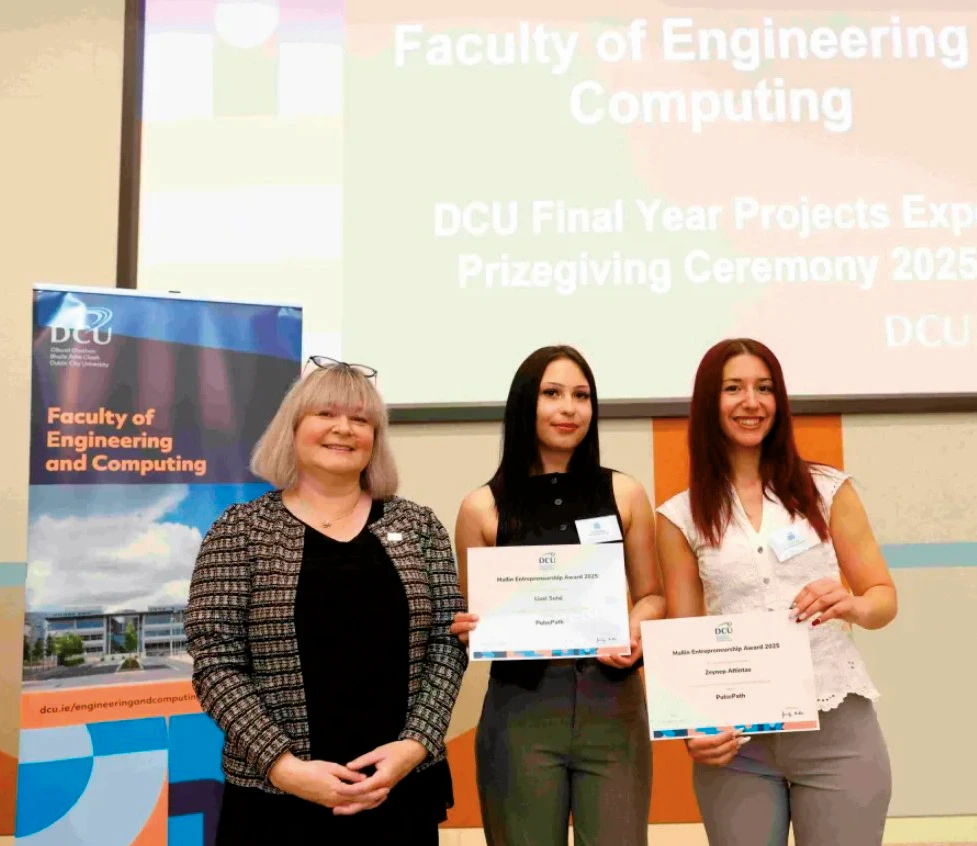
For their final-year project, Computing for Business students Zeynep Altintas and Lizel Sulaj created an app for monitoring crowd control at outdoor events. This promising business idea won them the Mallin Entrepreneurship Award, a seed fund for students created by DCU alumna and entrepreneur Liavin Mallin.
Developing market-ready products is part of the programme for final-year students on DCU’s Computing for Business course. As music fans and regular festival attendees, entrepreneurial students Zeynep and Lizel drew their product inspiration from the all-too-familiar issue of festival queues.
“We go to festivals all the time, and if we were to know what queues were less busy, we could spend our time watching the artists perform, instead of wasting 40 minutes in toilet queues,” Lizel explains. The students spotted a gap in the crowd control market. According to Lizel, “There’s nothing that’s hardware- free for festivals or outdoor events – and that’s when we realised that we had somewhat of a unique idea.”
Their product, PulsePath, is a web application designed to enhance crowd safety and resource management at medium- to large-scale open-air festivals. The platform provides real-time crowd density insights, enabling organisers to monitor congestion, improve response times, and allocate staff and amenities more efficiently. As Zeynep explains, she and Lizel created PulsePath from the ground up: “We were able to create the product, work on the business analysis and the coding side and everything else that goes into it.”
The pair put their project forward for the Mallin Entrepreneurship Award, which offers seed funding and mentorship – and their belief in PulsePath proved to be justified. Now based in an office in DCU Polaris, the duo are exploring feasibility and commercialisation funding that can take their idea to the next level.
Along with significant seed funding, winning the Mallin Entrepreneurship Award has given them an invaluable chance to meet other entrepreneurs and experts who can offer advice and support. “The guidance is the biggest thing, I think” Lizel says. “It’s a great way to have a first venture into the entrepreneurship world.”